

- Services
- Hydrophobic Treatment
Deep Hydrophobic Treatment — Protection That Penetrates the Material.
A process that permanently protects coarse-pored, capillary-active surfaces against penetrating water — with silicone impregnation that lines the pores instead of sealing them.
- Up to 95% reduced water absorption
- Penetration depth up to approximately 11–12 mm
- Vapor-permeable — water vapor continues to escape

What It’s About
Water Is the Most Common Threat to Structures.
In hydrophobic treatment, coarse-pored, capillary-like surfaces on structures are protected against water penetration. The degree of effectiveness ranges — depending on surface and material — from significantly reduced water absorption to complete water repellency.
For sealing, we work with silicone impregnation. Its decisive advantage: the stone pores are only lined, not sealed. This way, despite greatly reduced water absorption, natural water vapor diffusion is maintained — the structure can continue to “breathe”.
Typical Challenges
When Hydrophobic Treatment Provides Protection.
Frost Damage
Penetrating water freezes, expands, and fractures the material. Less water absorption means fewer spalling and cracks.
Salt & Pollutant Exposure
De-icing agents and dissolved salts penetrate with the water and damage the structure — especially on transportation and infrastructure projects.
Algae, Moss, Soiling
Moist surfaces promote growth. A dry surface stays clean and valuable longer.
How the Process Works
Lining Instead of Sealing.
The difference from film-forming coatings: silicone impregnation works within the depth of the building material, not just on the surface.
Penetration
The impregnating agent penetrates up to approximately 11–12 mm deep into the mineral building material — where water would otherwise cause damage.
Lining
The pore walls are lined hydrophobically. Water beads off, but can still escape as vapor.
Protection
Water absorption decreases by up to 95%. Frost, salts, and dirt lose their main route of attack — service life increases.
Vapor-Permeable — and That Is Precisely What Matters.
A hydrophobic treatment that seals the pores can trap moisture in the component and cause new damage over time. Our silicone impregnation deliberately avoids this.
Suitable Systems
Products for Hydrophobic Treatment.
Coordinated for mineral building materials and heavily weathered surfaces.
Deep Hydrophobic Treatment
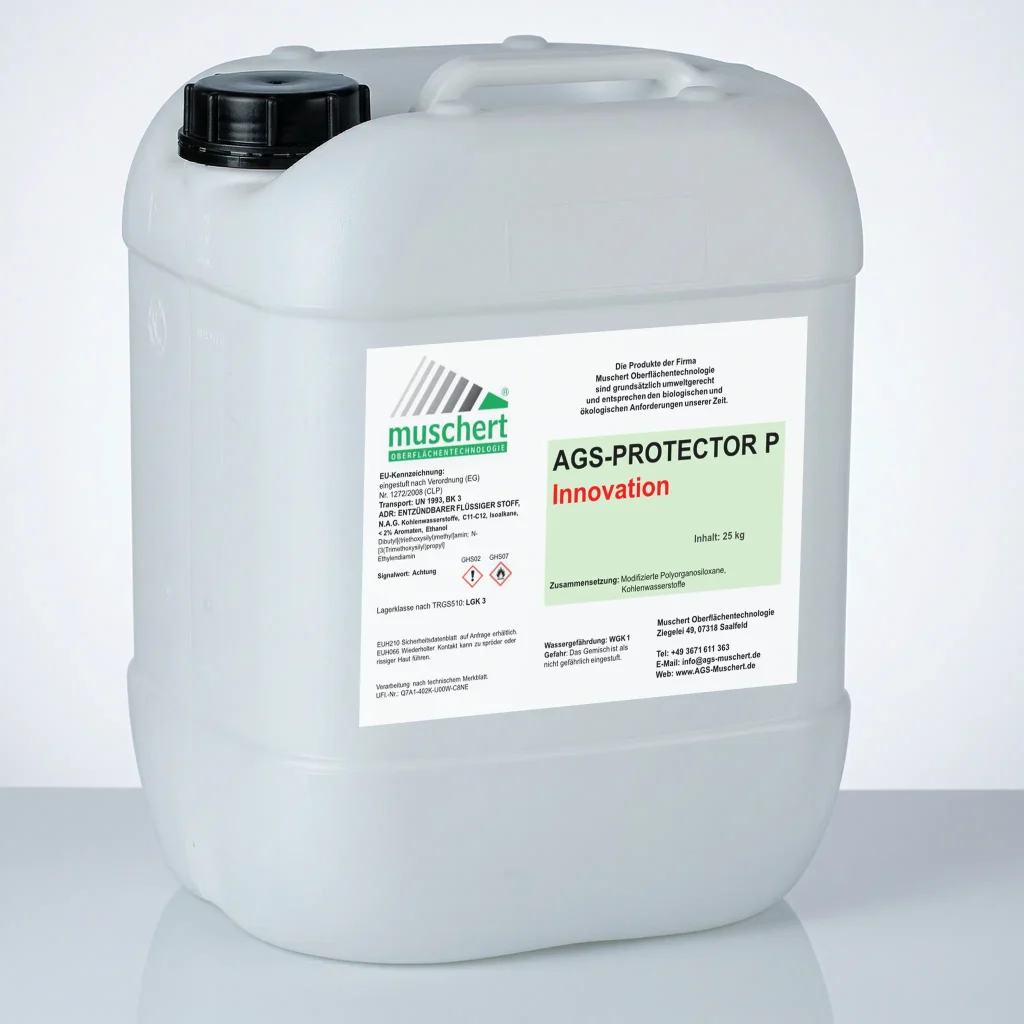
Silicone-based, up to 12 mm penetration depth – for concrete, clinker, and natural stone
Effective color protection that can be combined with preventive value preservation
Frequently Asked Questions and Answers About Hydrophobic Treatment
What Are the Benefits of Deep Hydrophobic Treatment?
Our deep hydrophobic treatments reduce water absorption by up to 95%, penetrate up to 12 mm deep into mineral building materials, and provide effective protection against frost damage, spalling, salt exposure, algae, and dirt. They remain fully vapor-permeable and extend the service life of structures while significantly reducing maintenance costs.
Which Surfaces Are Suitable?
Particularly mineral, coarse-pored building materials benefit — concrete, clinker, brick, and natural stone. Highly porous surfaces show the greatest effect. An on-site analysis clarifies suitability and exact consumption.
Does Hydrophobic Treatment Change the Appearance of the Surface?
No. Since the silicone impregnation penetrates into the pores and does not form a surface film, the appearance remains largely unchanged — no glossy film is created as with film-forming systems.
How Is the Correct Quantity Calculated?
The required quantity depends on material, porosity, and surface structure. Reference values: metal & smooth substrates 100–150 ml/m², concrete, clinker, and brick 150–250 ml/m². An on-site analysis provides exact consumption values.
Protect Your Structure Long-Term?
We analyze substrate and weathering on-site and recommend the appropriate hydrophobic treatment system.